
It's Been a Year!
Some reflections on the 1949 Pillsbury Bake-off, its contestants, and what I've learned in the past year

Name on the Recipe Card is a blog series about the unsung heroes of bygone kitchens, who competed and won a place at the national Pillsbury Bake-Off. Who are they? What are their names and stories? For many, they are only known by their husband’s names. Let’s shine a light on who they are and how they lived.
When I inherited the 10-year compilation cookbook of Pillsbury Bake-off Recipes from 1949 to 1959, I was immediately intrigued by the uniqueness of the recipes - jam mixed in cake batter? gum drops in bread? chopped marshmallows strewn on the bottom pie crust of a fruit pie? - and also immediately frustrated by the way the married women were listed… under their husband’s names. It hardly seemed fair that their moment of glory was credited to someone else’s name. I had spent some time researching my family tree so had all the tools to satisfy my curiosity about these women.
They Deserve To Be Known

I first met Erna in 1989, not long after falling head over heels for her son. She was this quiet, sturdy presence—understated in every way—living with her husband Bob on a leafy cul-de-sac in Massachusetts. Everything about her was the opposite of my own upbringing. My family? We’re huggers, loud talkers, always out to eat for celebrations. My mother, G…
It started with me tracking them down to find out who they were and some details about their lives, then regaling my husband with their stories while we indulged in their cakes. I can’t even remember what possessed me to start a blog about them, but it’s become such an important part of my life. It was my fifth post that made me realize there was something meaningful about what I was doing - that was a post about an independent woman named Aquina Shea who submitted a recipe for Minnesota Harvest Bars. A great-nephew of hers recognized her name but knew so little about her life. He was grateful to learn more and even attached the post to her entry in his family tree. I rode that high for a month.
Then there were more… someone recognized a picture of a friend’s aunt. Another, her great-grandmother about whom she knew little and was grateful for the deeper history. There was the woman who bought a contestant’s house and was baking in her same kitchen. And there were the cousins who were so excited to find their grandmother’s article. I was shocked at how many connections were being made for a little blog series with fewer than a hundred followers. But every connection moves me forward, keeps me baking and researching and sometimes falling in love with my subjects. One of those loves is Leona Funcke, an obviously happy woman in love with her husband and children, and with a deep love of baking.
Leona was in the Bake-off three times, starting with 1949, the year I’m currently focused on. And she kept scrapbooks for each one, which her granddaughter Jean scanned and shared with me. Both granddaughters, Jill and Jean, were generous with their time and memories, sharing stories about “Grandma Lee” over Zoom and email, all of which not only gave me a better idea about Leona but also about the Bake-off experience overall.
And that’s what I want to share now — a look back at what it was like to be a contestant in the 1949 Pillsbury Bake-off, which was unique among the bake-offs because it was the first and was actually intended to be the only. It also drew many middle-aged home cooks, most of whom learned to cook in their mothers’ kitchens during troubled times like World Wars, the Great Depression, the Dust Bowl. Their cooking often reflected those hardships, making do with what was available and affordable.
An enormous thanks to the Funcke family, especially Jill and Jean, for giving me such an intimate look at the inner workings of this iconically American event.
Applying
It was impossible to miss knowing about Pillsbury’s Grand National Recipe and Baking Contest. Pillsbury Mills was celebrating their 80th birthday amidst a push from the government for American housewives to use enriched flour in their recipes as a response to the rampant malnutrition afflicting the country. What better way to bring those two ideas together than to host a national baking competition for home cooks? They ran ads in just about every paper in just about every American city and town. Often the ads were accompanied by the rules. Many of these rules were tailored to home cooks of the era, many of whom learned to cook through oral tradition and through times of hardship and food shortages.
Basically, the rules were:
1. Keep the recipe neat and exact, using just one side of the paper you’re writing on. Use level measurements, not the more common notations of the day like “heaping” or “scant”. Indicate the exact oven temperature - not “medium” or “hot” - and how long to bake the item. In other words, translate the oral tradition and improvisation of home cooking into precision.
2. Keep it family-friendly and easy. No alcoholic ingredients were allowed. Pillsbury also insisted that ingredients be readily available in grocery stores. And most importantly, ingredients had to contain at least 1/2 cup of Pillsbury’s Best Flour, which was the brand name of Pillsbury’s enriched white flour.
3. Don’t just identify your name and the recipe title (although you need to do that on each sheet of paper) but also tell a little something about it. At the bottom of the recipe, tell where you learned it and when.
4. Include a seal from a Pillsbury Best flour package. This may seem trivial but, in the end, Pillsbury received 250,000 recipe submissions in that first year. That’s at least one bag of flour for each of them - not a bad way to influence sales. And if you wanted a chance at doubling the prize money, cut the “contest tokens” from the ad and put it in the envelope as well. You could also write to Pillsbury to ask for an entry form and contest token.
5. One entry per envelope, but feel free to send as many envelopes as you want.
Winning a spot
Regional Pillsbury representatives partnered with regional Department of Home Economics officials to read through the recipes and test the ones the complied with the rules. The test kitchen scored the recipes based on taste, ease of preparation, uniqueness, and general appeal. Interestingly, they also judged the “aptness of name”, which is ironic because Pillsbury almost always renamed the recipes before publishing. There were six categories in this first contest: Pies, Cakes, Cookies, Breads, Entrees, and Desserts. Pillsbury would place each entry into the appropriate category for competition.
Finalists were notified by phone or home visit by Pillsbury’s regional representative. In those days when not all homes had phones, it could be challenging to notify the contestants. Sometimes, the representative would arrive unannounced, with photographer in tow, to present the finalist with a $200 check and a congratulatory letter from Pillsbury. This not only surprised finalist Christena Ornburn but it also alarmed her to be caught unprepared for a photo opp. In another story, Pillsbury had trouble locating Erma Hamilton because she didn’t have a phone and lived on a rural farm road, they called the local police station for advice on how to find her. It turned out her father was the chief of police and ran out to the rice fields to tell Erma himself!
Importantly, Pillsbury was careful to point out that all the recipes became their property and would not be returned to the contestant. This paved the way for them to modify the recipe, recipe name, and cooking instructions as they saw fit. Finalists received congratulatory legal documents to sign that explained how the ownership worked, which included name and recipe changes, as well as instructions not to share the recipe or provide photos of the finished product to newspapers.

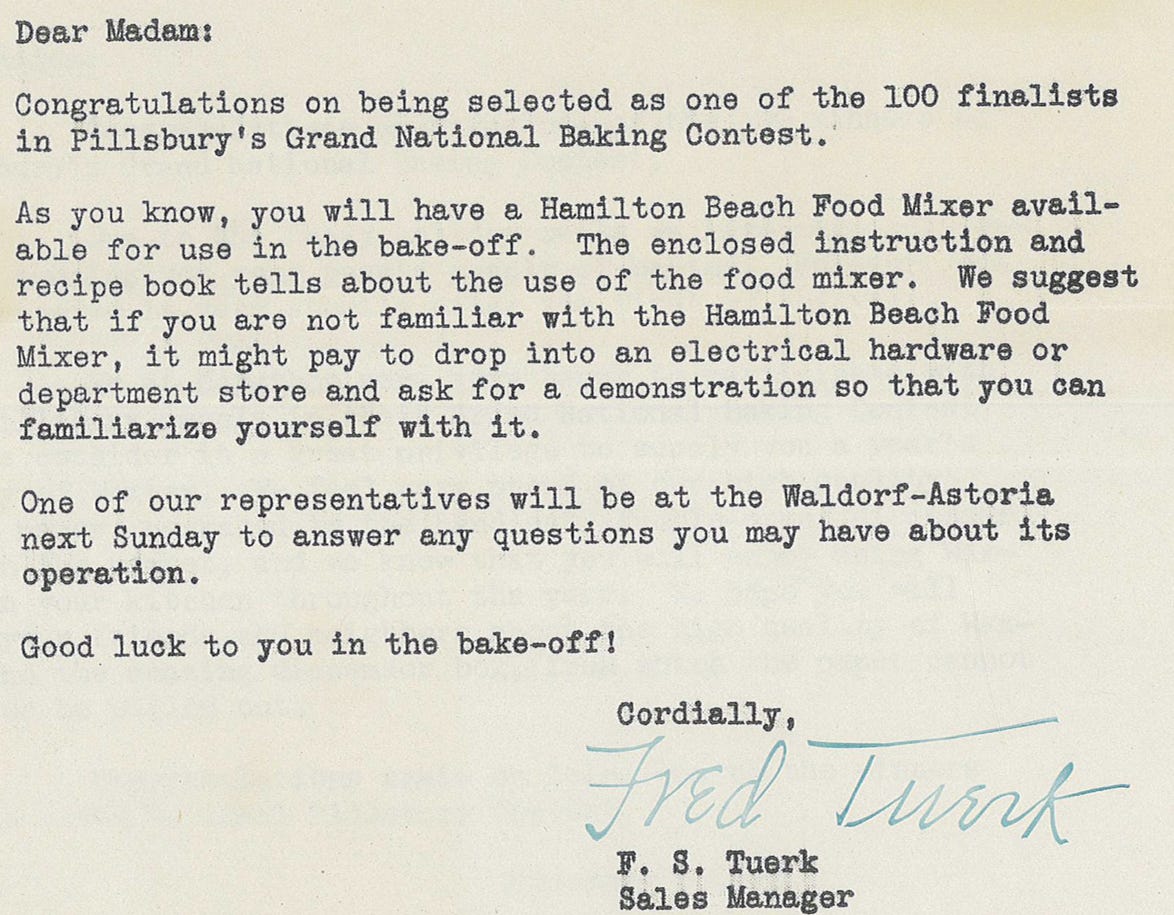
But Pillsbury Mills wasn’t the only company leveraging this event for promotional purposes. A flurry of congratulatory letters arrived in finalists’ mailboxes from all the other vendors, including General Electric, Hamilton Beach, and the Waldorf Astoria. For many of these women, modern appliances like electric stoves and food mixers were just things they had heard about but never used. The vendors were careful to provide avenues for them to learn what they needed to know before baking in the finals.
Competition Day
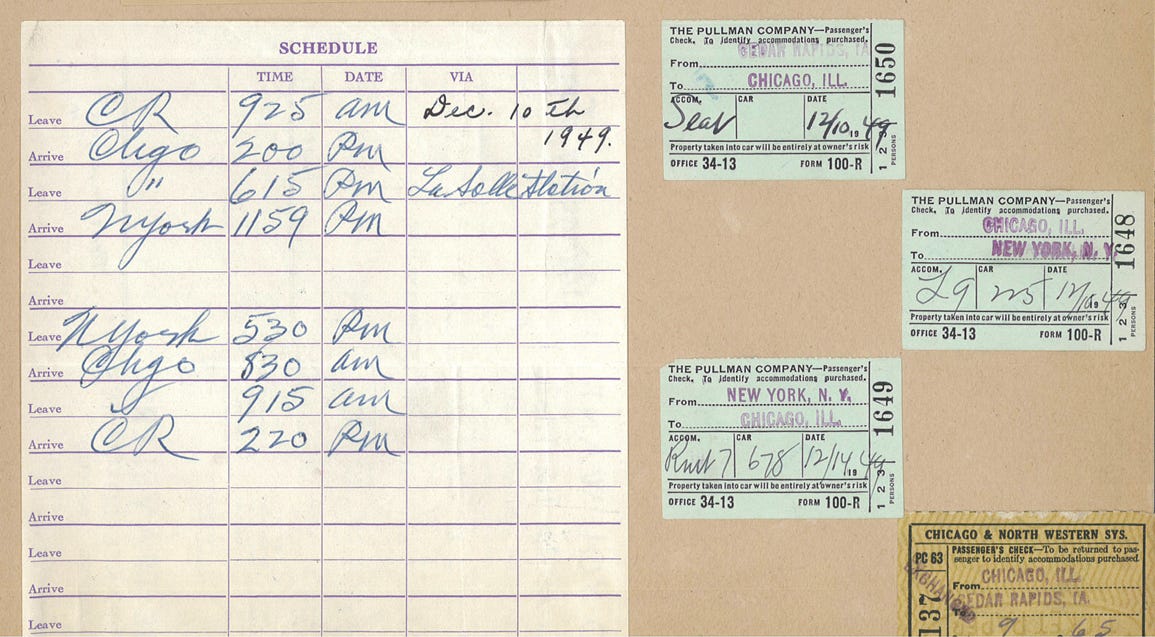
In 1949, air travel was not as ubiquitous as it is now. Contestants not only won $200 for making it to the finals, they also received an all-expense-paid trip to New York. However, for some, that included lengthy train travel to get there.
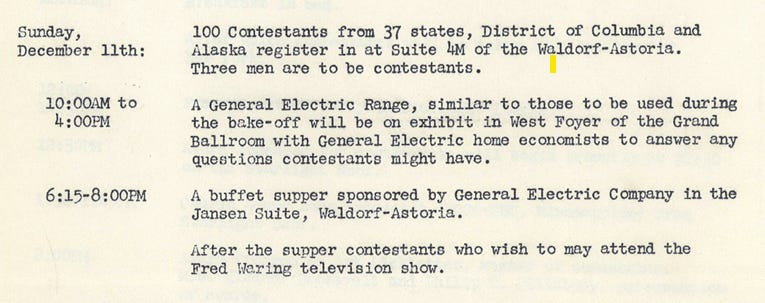
Once there, they had a detailed (and rather full) schedule for the weekend, including one full day of baking. Arrival day was the lightest schedule for the contestants, some of whom had traveled a long way before arriving at the Waldorf-Astoria. The afternoon was reserved for demonstrations of the equipment the contestants would be using and answering any questions they might have.
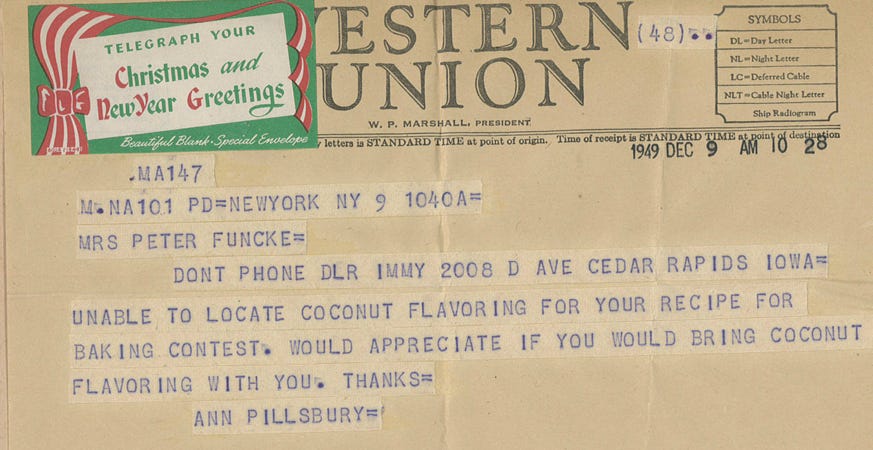
Some of the contestants took the offer to be in the audience for the Fred Waring show, but many retired to their rooms to get some rest for the next day, baking day. The next day started early and allowed for some additional time to get their questions answered before the baking began. Most ingredients were purchased by Pillsbury and were waiting for the contestants at their stations, but in some cases, contestants were asked to bring specific items that staff was unable to find.
By the time the doors opened on the morning of December 13, 1949, the Grand Ballroom of the Waldorf-Astoria no longer resembled a ballroom at all. Overnight, Pillsbury’s home economists and a small army of electricians had transformed it into something closer to a gleaming aircraft hangar of domestic ambition — one hundred General Electric Stratoliner ranges, each one squared precisely in rows that stretched from the stage to the far wall like a regiment of white enamel soldiers.
Baking began at 8:30 AM and ended at 5:00 PM, but this was a fairly loose schedule. Each contestant would be allowed as many attempts as they could fit into that schedule (I imagine bread bakers were feeling the pressure of this schedule more than cake or cookie bakers). Judges were ready to take submissions right away in the event that the contestant was satisfied with the first attempt, which several were.
Judges were sequestered from the contestants and were not allowed to meet or see the bakers before final awards. The judges were food editors from various publications and were isolated in a separate room. When a contestant was finished with their item, they would place it on a service cart and wheel it to the doorway of the judging hall. They were then free to leave the baking hall or stay to watch the others wrap up. That day in 1949, the first entry came to the judges at 10:45; according to Clementine Paddleford, Food Editor for the New York Herald Tribune and one of the judges, they had sampled all 100 entries by 5:30 PM. With so much sweet food to try, the judges balanced their palates by nibbling on green olives and dill pickles, along with lots of water despite the water shortage going on in New York City that weekend.
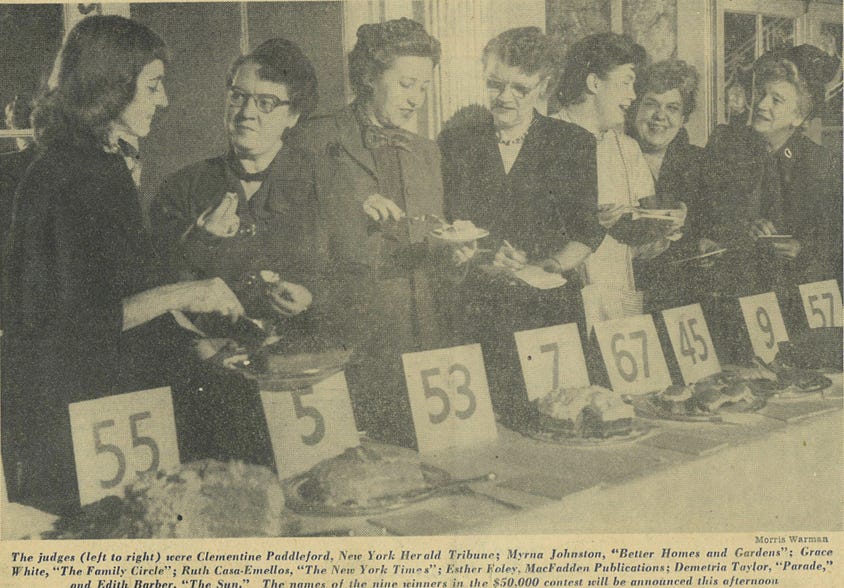
One judge later admitted that she felt the pies made the “poorest showing”, although she didn’t explain what that meant. All in all, the consensus among the judges was that the quality was good for all of the entries but there were few things that were groundbreaking. Many of the entries were variations of American standards; I look back with a historical eye and wish to disagree with those judges. Maybe we have become accustomed to having any ingredient available to us, either in our grocery stores or online, but it takes a certain creativity to make beautiful cakes and pillowy bread and multi-layer pies when so many home cooks had lived through decades of food shortages.
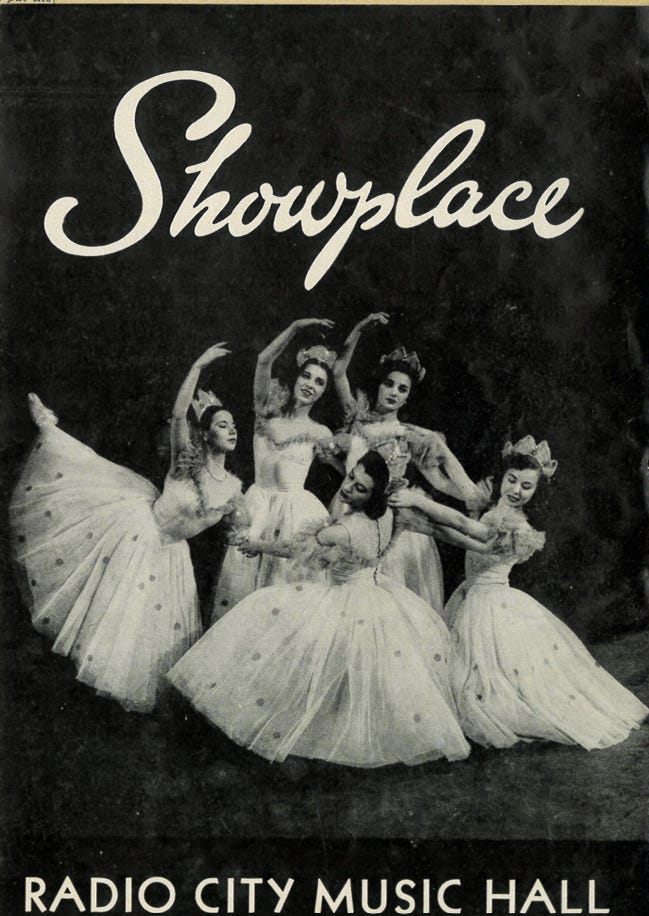
Exhausted contestants went right from the baking hall to a supper sponsored by LIFE magazine. For those with any energy left, Pillsbury whisked them off to either a show at Radio City Music Hall or to Arthur Godfrey’s show, “Talent Scouts”. This was undoubtedly a good way to keep your mind off how you did in the competition.
Awards Day
The next day started slowly, which was undoubtedly a relief. Contestants were treated to a room service breakfast, a luxury many had never experienced. Then they were taken on a bus tour of New York City. While the contestants were sightseeing, the press was beginning to gather at the Waldorf-Astoria’s Starlight Lounge for a noon cocktail party (it’s 5:00 somewhere!).
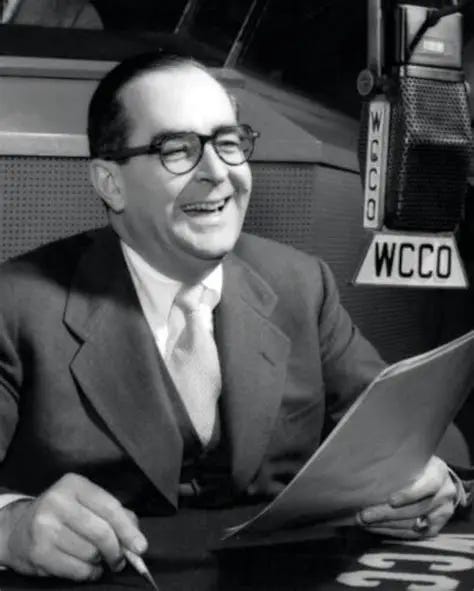
Contestants joined the press corps on the Starlight Roof at 12:30 for the awards luncheon, which was studded with A-listers, including Philip Reed (Chairman of the Board for General Electric), John Pillsbury (Chairman of the Board for Pillsbury Mills), Frank Stanton (President of CBS), Mayor Impelliteri, Otis Wiese (Editor of McCall’s Magazine), Arthur Godfrey, Art Linkletter, and Eleanor Roosevelt. As if all of that wasn’t exciting enough, the awards presentation was broadcast live (and later re-broadcast during prime time) on CBS, hosted by Cedric Adams, one of the best-known broadcasters of the time.
After the awards were announced, most of the contestants were free to leave while the top three award winners attended a press conference with Mrs. Roosevelt. The top awards went to Theodora Smafield for her water-risen bread twists (first prize of $50,000), Laura Rott for her chocolate mint cookies (second prize of $10,000) and Virginia Sprague for her chocolate layer cake (third prize of $4000).
No contestant went away empty-handed though. They all received brand new General Electric Stratoliner push-button electric ranges, which were delivered to their homes by their regional GE product suppliers. All of the ovens used on the baking floor of the Waldorf-Astoria were demonstration units and did not follow the contestants home. The same is true of the Hamilton Beach electric mixer, which were also demo models in the competition. Contestants received brand new mixers from local appliance stores in their area.
This past year has given me a new perspective on the lives of people, especially women, in the first half of the 1900s. It’s easy to trivialize the homemakers of the 1940s and 1950s, until you realize how difficult the path was to arrive at that place. Many of these contestants were born in the years before WWI. They said good-bye to lovers and brothers (and sometimes sons), and sacrificed food and household goods so the troops could have enough supplies. Immediately after the war ended and the survivors arrived home, the Spanish Flu swept the country, leaving people stranded and isolated, with continued shortages. There was a decade of calm in the 1920s and many of these contestants married during that time and had their babies. But then, while their children were small, the Great Depression took away their stability and again, food was scarce. Homemakers who had learned to make do with minimal ingredients went to work again, creatively feeding their families on whatever they could find and afford. The Dust Bowl overlapped the Depression, leaving America starved for fresh produce that was grown in that region. And just as farmers were rebuilding their fields, America entered WWII. Women once again said goodbye to lovers, brothers and sons, while also facing food rationing in a country already struggling.
The 1949 Pillsbury Grand National Recipe and Baking Contest, with its focus on female homemakers, was just 4 years after WWII veterans came home. Rationing and food shortages continued through this time while America helped to rebuild European countries. The Bake-Off might smell of patriarchy and condescension. But I’ve come to appreciate that it was also a way to celebrate the incredible feat of keeping families fed, of making beautiful desserts out of whatever was available, and of being the anchor in so many households.
Thank you for being part of the journey so far. I’m looking forward to finishing up my research on the 1949 contestants over the next year. Please join me!
What a wonderful project! I can’t believe it took me so long to stumble upon it. Love this time period. Keep up the good work!
How amazing! What a wonderful overview of the Bake-Off. In times of lack and loss, how exciting it must have been to be whisked away to New York City, maybe the only real long-distance travel for many contestants. Just curious. . . so far, have all the contestants been women? Of course, I can't help but think this would be a great intro to a cookbook of historical recipes.