
1949: Banquet Layer Cake
Not-your-average white cake, filled with a cherry coconut walnut filling by Mrs. Ome Ornburn, an award-winning baker whose name should be known

Name on the Recipe Card is a blog series about the unsung heroes of bygone kitchens, who competed and won a place at the national Pillsbury Bake-Off. Who are they? What are their names and stories? For many, they are only known by their husband’s names. Let’s shine a light on who they are and how they lived.
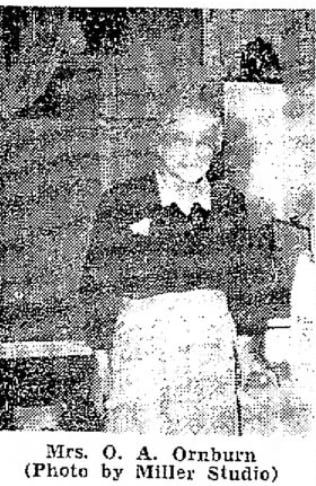
When the regional representative arrived at her house to tell Christena Ornburn she’d been selected to attend the inaugural Pillsbury Bake-off, she admitted she “went all to pieces,” especially because she was sure her hair was “a fright” when the photographer showed up. She would be happy to know that all that is left for us of that photo is this rather indistinct version. We have no idea if her hair is a fright.
Christena May Durbin was born on May 4, 1877, in Clay, Missouri, the first of Benedict and Amanda Durbin’s six surviving children. She grew up in a household shaped by hard work and frontier grit. Her father, Benedict, had fought in the final year of the Civil War and later farmed the Missouri soil. Her mother, Amanda, had crossed into Missouri as an eight‑year‑old in a covered wagon and lived to the remarkable age of 93. Christena grew up watching her mother keep a bustling home and her father work through the aches and pains that eventually took his life in 1897, when Ben Durbin died of rheumatism.
Just a few months before her father passed, Christena married a young Missouri man named Ome Arthur Ornburn in September 1897. She was twenty, he was twenty‑three, and they started out the way many young couples of their time did—on a farm. Ome farmed at first, but over time he shifted into blacksmithing, and Christena found her own way of contributing by sewing for neighbors out of their home. They stayed in Clay Missouri until 1912, raising their growing family: Benedict, born in 1900; William in 1905; and Harry in 1911.
In 1912, the Ornburns made the move that would define the rest of their lives. They settled in Moberly, in a modest but sturdy house just shy of 2,000 square feet—not a spare inch to waste with three boys who surely shared a room.
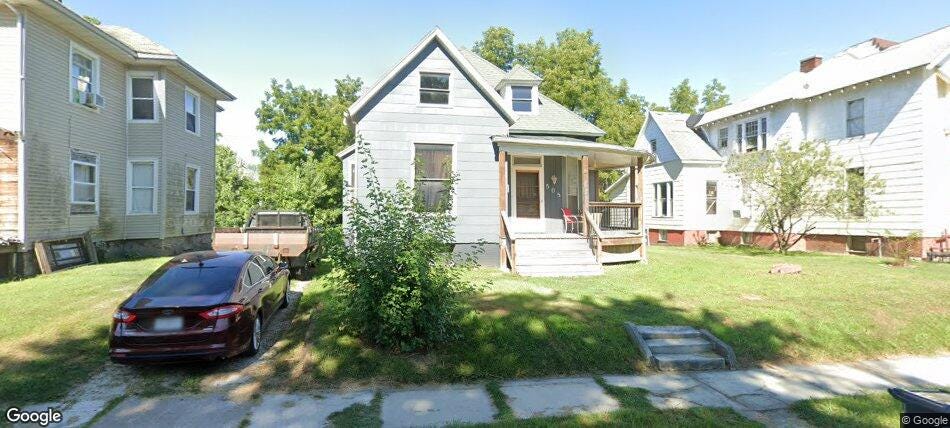
Despite the tight quarters, Christena and Ome ran a boarding house, taking in two lodgers at a time, some of whom stayed with them for years. Christena carried most of the load: the cooking, the cleaning, the laundry, the endless churn of meals and linens. But the house had a yard, a sidewalk-lined street, and a sense of community that made it home.
Ome took a job as a registration clerk at a local hotel, and Christena continued to keep house. Somehow, amid all of this, she still found time for herself. She belonged to the Ever Busy Sewing Club—an apt name if ever there was one—and often hosted gatherings in her home. She also played cards with the Nonesuch Bridge Club, adding a little social sparkle to her otherwise demanding days.
In 1933, Ome took on a new job as custodian at Trinity Church, where the Ornburns were longtime members. Fourteen years later, in 1947, tragedy struck quietly. Ome went to work one morning but didn’t come home for lunch as he always did. Their sons William and Harry went to the church to check on him and found him in the basement, gone from a sudden heart attack at age 73. He and Christena had been married fifty years.

After losing Ome, Christena stopped taking in lodgers. She was seventy by then, and she had earned her rest. Her mother Amanda, now elderly herself, sometimes came to stay with her and William, who still lived at home.
Then came 1949—the year Christena stepped into the national spotlight. At age seventy‑two, she submitted her Millionaire White Cake to the very first Pillsbury National Competition. She was surprised to find out she had won a spot at the national competition in New York City. Ome had been gone two years, but William was still at home and insisted on accompanying her to New York. Christena worried about leaving her ninety‑one‑year‑old mother, but William encouraged her to enjoy the moment for once. And she did. It was the first trip to the East Coast for both of them, and Pillsbury treated the contestants like celebrities—luxury accommodations, fine meals, tours, radio shows, even television appearances. Christena claimed she wasn’t nervous once the competition began, though William, witness to the event, gently disagreed. After the awards luncheon, she even had time to visit an old Moberly friend, Mary Haden, who had moved to New York.
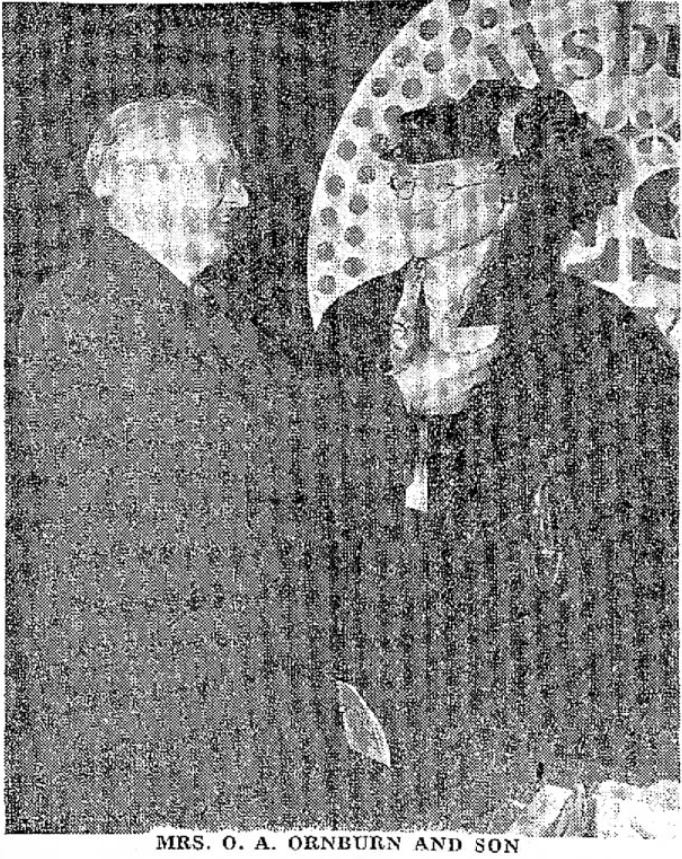
She returned home with a brand‑new kitchen—too late for her former lodgers, but perfect for cooking for herself, William, and the friends who dropped by. And in true Christena fashion, she confessed to the local paper that although Pillsbury made her sign an agreement not to reveal her recipe, she had already shared it with half of Missouri.
Her sons built their own lives. Benedict, the eldest (who went by B.J.), registered for both World Wars and became a design engineer for the Montana State Highway Department. In 1939, he won a national award for a bridge he designed over the Flathead River in Belton, Montana. It is now the main bridge for the West Entrance to Glacier National Park.
![[West Glacier Bridge Dedication, 1938].](https://substackcdn.com/image/fetch/$s_!KnrT!,f_auto,q_auto:good,fl_progressive:steep/https%3A%2F%2Fsubstack-post-media.s3.amazonaws.com%2Fpublic%2Fimages%2Fce9f7816-2c2f-4a79-b643-1e953f2c3ac6_1000x796.jpeg "[West Glacier Bridge Dedication, 1938].")
William, the middle son, never married and lived his entire life in the family home, eventually becoming principal at West Park School. He died in 1966 at age 61 from a heart attack. Harry, the youngest, married in 1940, served in WWII from 1943 to 1946, and later owned a butcher shop in Moberly. He served as executor of his father’s estate when Ome died.
Christena died in March 1964 of arteriosclerotic heart disease and kidney disease. Her longtime family doctor signed her death certificate, having cared for her for forty‑eight years. It noted that she never had a Social Security number. Social Security numbers were introduced in 1936, when Christena was already 59. They were originally designed just to track workers’ wages so they could collect Social Security benefits. It made sense that Christena would never have applied for one, since she was older and had never worked outside the home. Despite running a boarding house, the census never listed her as ‘employed’ but rather categorized her work as ‘keeping house’, disqualifying her for Social Security benefits.
She was laid to rest in Oakland Cemetery in Moberly, beside Ome, closing the story of a woman who spent her life caring for others and staying close to home, making her mark through family, community, and, in one glorious moment on the national stage, a prize‑winning cake.
Let’s Make Cake!
If there’s one kind of cake that stands out in these vintage recipes, it’s white cake. Lightly sweet and reliant on a lot of egg whites for its delicate sponge, white cakes were considered elegant treats for dinner parties or church gatherings. Christena’s version is one of the best from the Pillsbury collection. While she goes one step beyond most other contestants by creating a three-layer cake, the real difference with her cake is in the filling. She sets aside some of the frosting and mixes in maraschino cherries, nuts, and coconut. The result is all the elegance you expect from a white cake with white icing but with the richness of the luxurious filling.
Note: I used Luxardo Maraschino Cherries and I highly recommend them if you can afford the extra expense. Unlike the fire-engine red sticky sweet maraschinos most of us are familiar with, these are rich and dark in a smooth dark syrup.

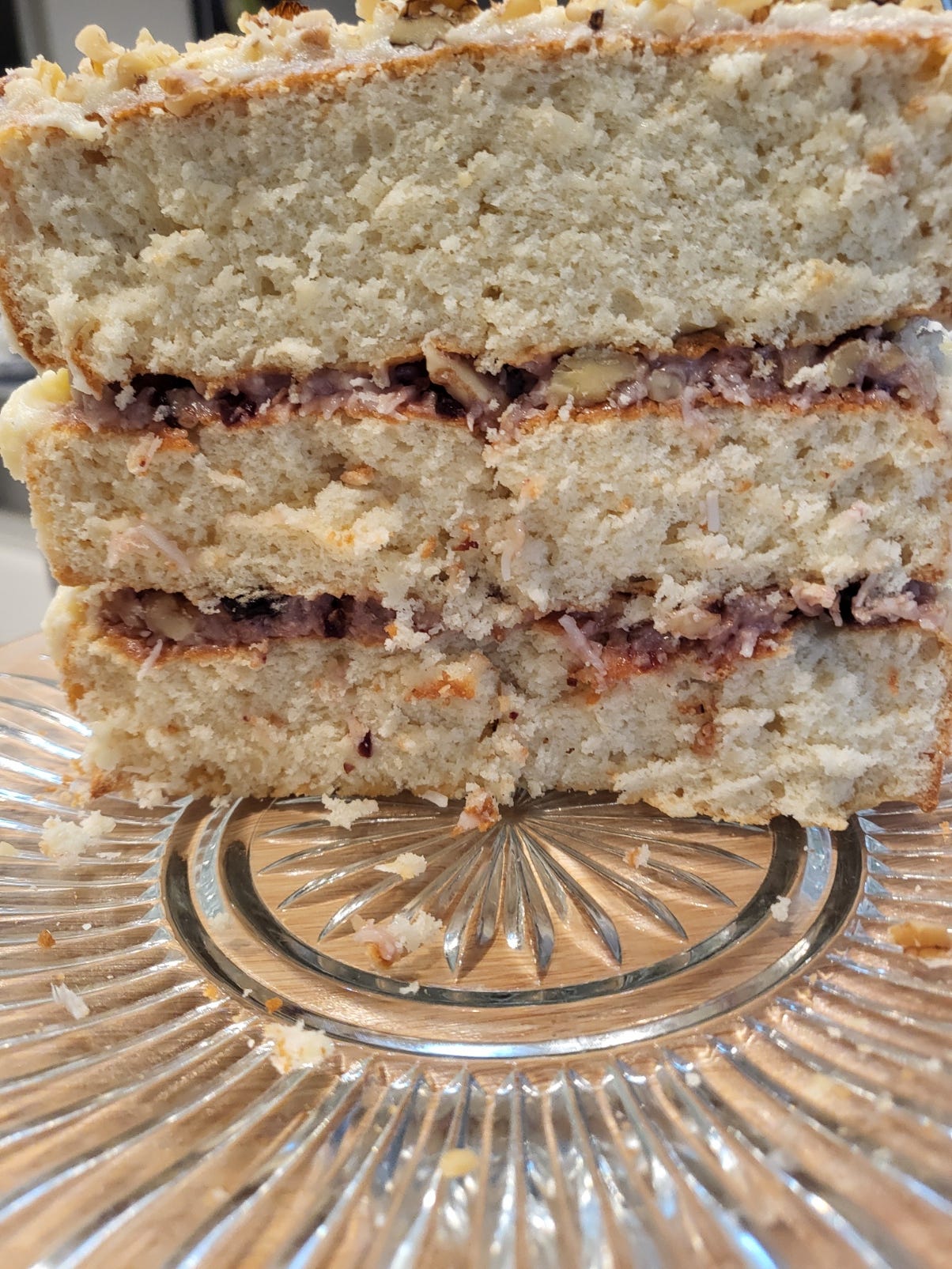
Verdict: This cake was a big hit in our house. We both loved it. It’s got the lightness and mild sweetness of a white cake but with an up-leveled flavor profile from the additional ingredients in the filling. Note that the version shown above uses a vanilla buttercream icing applied lightly. Christena’s version uses a boiled white frosting, which would also be delicious.
If you’d like to recreate this excellent cake and impress all your friends and family, here’s Christena’s Millionaire White Cake recipe:
(Recipe published in the 1959 edition of “Pillsbury’s BEST of the BAKE-OFF Collection”)
Makes three 9-inch layers
Sift together and set aside:
3 c. sifted all-purpose flour
3 1/2 tsp. double-acting baking powder
1 tsp. salt
Cream:
3/4 c. butter or margarine (I used European-style butter)
1 1/2 c. sugar
Combine:
1 1/3 c. milk
1 tsp. vanilla
1 tsp. almond extract
Add alternately with the dry ingredients to the creamed mixture. Blend well after each addition.
Beat:
7 egg whites (3/4 cup) until stiff but not dry. Gradually add 1/2 c. sugar, beating until stiff.
Fold:
beaten egg whites into batter.
Bake at 350 degrees for 25-30 minutes. Cool; fill and frost with De Luxe Fluffy White Frosting.
De Luxe Filling:
Remove one-third of De Luxe Fluffy White Frosting to small bowl. Stir in 1/2 c. chopped nuts (I used walnuts), 1/4 c. chopped drained maraschino cherries (see Note above), and 1/2 c. coconut.
De Luxe Fluffy White Frosting
Combine in top of double boiler:
2 egg whites
2/3 c. sugar
1/2 c. light corn syrup
3 tbsp. water
1/2 tsp. cream of tartar
Place over boiling water and beat until mixture stands in peaks. Remove from heat. Add 1 tsp. vanilla and continue beating until thick enough to spread.
Sources:
Pillsbury Mills, Inc. (1959). Best of the bake-off collection: Pillsbury’s best 1000 recipes. Consolidated Book Publishers, Chicago; distributed by Grosset & Dunlap
Benedict Ornburn Wins First Prize on Bridge Design. (1939, July 31). Moberly Monitor-Index and Moberly Evening Democrat, p. 8.
News. (1897, December 10). The Monroe County Appeal, p. 3.
Mrs. Ornburn, 86, Dies; Mother of School Principal. (1897, December 24). The Monroe County Appeal, p. 4.
Mrs. Ornburn Has ‘Time of Life’ at ‘World Series’ Baking Contest. (1949, December 15). Moberly Monitor-Index and Moberly Evening Democrat, p. 4.
Mrs. Ornburn Off Saturday for National Baking Contest. (1949, December 6). Moberly Monitor-Index and Moberly Evening Democrat, p. 1.
Recipe Wins Valuable Prizes and New York Trip for Mrs. Ornburn. (1949, December 6). Moberly Monitor-Index and Moberly Evening Democrat, p. 1.
O.A. Ornburn Found Dead in Trinity Church. (1947, April 9). Moberly Monitor-Index and Moberly Evening Democrat, p. 1.
Social Calendar. (1938, December 20). Moberly Monitor-Index and Moberly Evening Democrat, p. 5.
Society. (1938, December 17). Moberly Monitor-Index and Moberly Evening Democrat, p. 3.
The cake sounds yummy, but I can't stop thinking about the fact that she worked her whole life and fell through the bureaucratic cracks so she never received any Social Security. It makes me wonder how many other women fell into this crack in the system.
It's really amazing how marginalized women were during those bake-off years. She worked like crazy her whole life, but was considered unemployed. She was referred to only by her married name. No doubt she probably had to put her prize money in a bank account belonging to her son, since without a SS number, she probably couldn't have one. No credit card either if she died in 1964. Yet at 72, she earned a brand new kitchen, well beyond the age her male relatives were doing anything. Her cake sounds tasty too.